When a server goes down at 7:15 a.m. or a team member gets locked out before payroll runs, the debate around outsourced it support vs in house stops being theoretical. It becomes a business continuity question. The right choice affects response times, security, staffing costs, project execution, and how much risk your business carries when something breaks.
For small and mid-sized businesses, this is rarely a simple either-or decision. Some organizations benefit from a full internal IT team. Others get stronger coverage and better value from an outsourced provider. Many land somewhere in the middle with a blended model. The best fit depends on your size, complexity, compliance needs, growth plans, and how much day-to-day support your operation actually requires.
Outsourced IT support vs in house: what changes day to day?
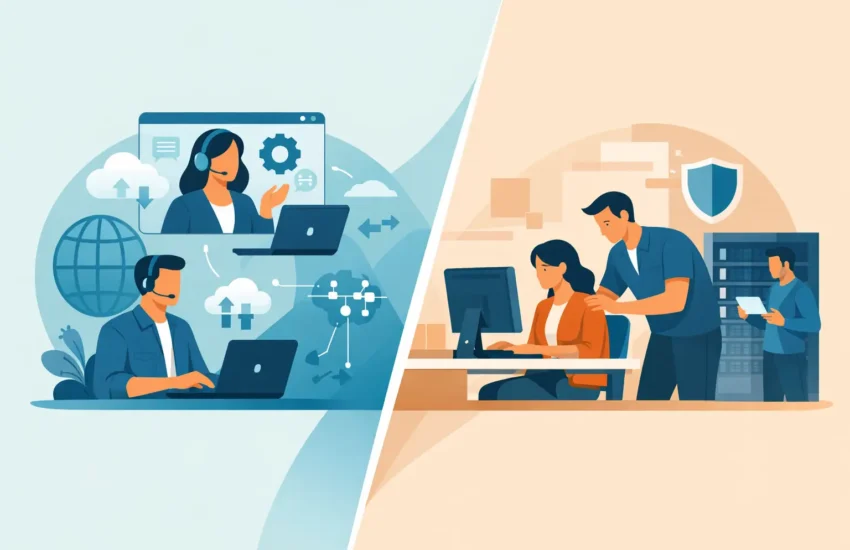
On paper, both models are meant to do the same thing: keep systems running, resolve user issues, protect data, and support business operations. In practice, they work very differently.
An in-house IT team gives you direct access to dedicated employees who know your people, your systems, and your internal workflows. They are physically and organizationally close to the business. That can be a major advantage when your environment is highly customized or when your staff relies heavily on face-to-face support.
Outsourced IT support gives you access to an external team that provides helpdesk services, monitoring, administration, maintenance, and project support under a service agreement. Instead of relying on one or two internal hires, you gain access to broader technical coverage, more consistent availability, and a wider skill set across multiple systems and platforms.
The biggest operational difference is depth versus breadth. In-house support often gives you deeper familiarity with one environment. Outsourced support often gives you broader expertise and more reliable coverage across many types of issues.
Cost is not just salary
Cost is usually the first factor leaders look at, but it is also the one most often underestimated.
An in-house IT employee costs more than base salary. You also need to account for benefits, payroll taxes, recruiting, training, certifications, management time, equipment, and turnover risk. If you need 24/7 support, security oversight, infrastructure management, and project capability, one employee is rarely enough. Even a small internal department can become expensive quickly.
Outsourced support is typically more predictable. Most providers offer monthly pricing based on users, devices, service scope, or support hours. That predictability helps with budgeting, especially for organizations that want stable IT costs without adding headcount.
That said, outsourced support is not automatically cheaper in every case. If your company has very limited technology needs and a stable environment, a capable internal generalist may cover what you need at a reasonable cost. But once your business depends on cloud apps, endpoint security, backups, compliance controls, vendor coordination, and fast incident response, the economics often shift. Paying for a team can make more sense than trying to build one role at a time.
Coverage and availability often decide the issue
This is where many businesses feel the difference most clearly.
An in-house technician can be excellent, but they can only work so many hours. They take vacations. They get sick. They may be tied up on a project when urgent tickets come in. If your IT support depends heavily on one person, you have a single point of failure.
With outsourced support, coverage is usually built into the service model. That means more than one technician can respond, issues can be escalated faster, and monitoring continues after hours. For businesses that operate across locations, support remote staff, or rely on systems outside normal business hours, that availability matters.
This does not mean every outsourced provider delivers the same level of responsiveness. Service quality varies widely. Some vendors are slow, rigid, or overly reliant on ticket queues. Others operate like an extension of your business and focus on prevention as much as repair. The provider matters as much as the model.
Expertise: specialist access versus institutional knowledge
One of the strongest arguments for in-house IT is familiarity. Internal staff often understand the personalities, business processes, legacy systems, and exceptions that never make it into documentation. They know which printer always fails before a board meeting and which accounting workflow cannot tolerate downtime.
That context is valuable. It speeds up support and reduces friction.
But expertise is not just about familiarity. It is also about range. Modern businesses rely on Microsoft 365, cloud platforms, firewalls, endpoint protection, backups, mobile devices, VoIP systems, wireless networks, compliance controls, and third-party software vendors. It is difficult for one or two internal employees to maintain high-level expertise across all of it.
Outsourced providers usually bring a bench of specialists. That can mean better guidance on infrastructure upgrades, better security oversight, and faster resolution for issues that fall outside a generalist’s experience. If your environment is growing more complex, access to that wider technical depth can be a practical advantage.
Security and risk management
Security is where the outsourced it support vs in house conversation gets more serious. Businesses are not just choosing who resets passwords. They are deciding who manages patching, endpoint protection, access controls, backups, monitoring, and incident response.
A strong internal IT team can absolutely manage security well, especially if the business invests in tools, training, and clear processes. The problem is that many small businesses do not have the resources to build that level of maturity internally. Security responsibilities get added to someone’s already full workload, and gaps start to appear.
An outsourced provider can bring structure. That often includes routine patching, proactive monitoring, standardized security practices, documentation, backup oversight, and faster response to suspicious activity. For businesses without a dedicated internal security function, that added discipline can lower operational risk.
Still, outsourcing does not remove accountability. Your business is still responsible for choosing the right partner, setting expectations, and reviewing performance. Security improves when there is ownership on both sides.
When in-house IT makes more sense
There are situations where building internally is the better move.
If your company is large enough to support multiple specialized roles, an internal department may offer the control and embedded support you need. The same is true if you operate in a highly customized environment with proprietary systems, strict physical access requirements, or constant hands-on technical demands.
In-house IT can also be the right fit when technology is central to your product or operation rather than a supporting function. If IT decisions are tightly woven into daily operational planning, having staff inside the business may improve coordination.
The key is scale. In-house works best when you can support enough coverage, specialization, and process maturity to avoid depending on one overwhelmed person.
When outsourced IT support makes more sense
For many small to mid-sized businesses, outsourcing is the more practical model.
It works especially well when you need dependable support but cannot justify hiring a full internal team. It also makes sense if your current setup is reactive, your staff wait too long for help, or you have aging systems without consistent monitoring and maintenance.
Outsourcing is often the stronger choice when your business needs a mix of helpdesk support, infrastructure management, cloud administration, user support, project assistance, and after-hours responsiveness. Instead of trying to hire each capability separately, you get a support structure that is already in place.
This is where a managed services partner can make a measurable difference. A company like BizByteIT is built to provide ongoing support, proactive monitoring, and practical technical guidance without forcing a growing business to build that capability entirely on its own.
The hybrid model is often the smartest answer
A lot of businesses do not need to choose one side completely.
A hybrid model gives you internal ownership where it matters most and outsourced support where scale and specialization matter more. For example, you may keep an internal IT manager who understands the business and handles vendor strategy, while an outsourced team delivers helpdesk coverage, system monitoring, security maintenance, and infrastructure support.
This approach can reduce staffing pressure without giving up internal visibility. It also helps businesses grow more safely. Instead of delaying support until problems pile up, you can add external capacity before downtime, security issues, or project backlogs start affecting operations.
How to choose without overcomplicating it
Start with the reality of your business, not the ideal version of it.
If your current environment depends on one person, has frequent support delays, lacks after-hours coverage, or struggles to keep up with maintenance and security tasks, outsourcing deserves serious consideration. If your systems are highly specialized and require constant in-person coordination, internal support may still be essential.
Ask a few practical questions. Do you need coverage beyond business hours? Are your tickets resolved quickly and consistently? Can your current setup support growth, security demands, and planned projects? Are you paying for downtime in ways that do not appear on an IT budget line?
The right answer is the one that gives your business reliable support, manageable risk, and room to operate without technology becoming a daily interruption. That is the standard that matters.
If you are weighing outsourced IT support vs in house, focus less on labels and more on outcomes. The best model is the one that keeps your people productive, your systems stable, and your business moving when the unexpected happens.
