
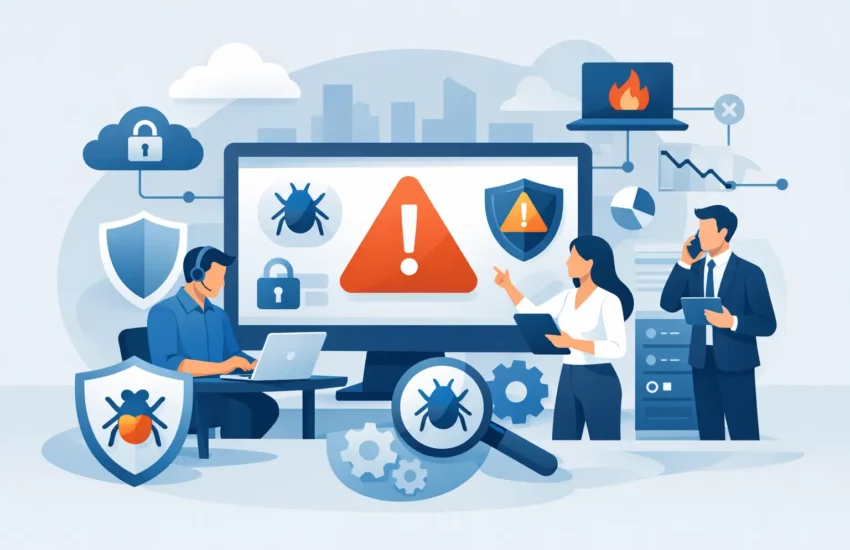
When a server goes down at 10:30 on a Monday, the issue is rarely just technical. Orders stall, staff lose access, customers wait, and leadership starts asking how long the disruption will last. That is where business IT incident response services matter most – not as a vague security add-on, but as a practical way to restore operations quickly and limit the impact on the business.
For small and mid-sized companies, incidents come in different forms. Sometimes it is a cyber event like ransomware, suspicious logins, or malicious email activity. Other times it is a failed network switch, a cloud service outage, a broken update, a file access issue, or a line-of-business application that suddenly stops working. The common thread is urgency. When systems are unavailable or compromised, every minute counts.
What business IT incident response services actually cover
Many business leaders hear the term and think only of data breaches. In practice, business IT incident response services are broader than that. A strong response function is built to detect, assess, contain, remediate, and recover from events that interrupt normal operations or put business data at risk.
That can include security incidents, but it also includes operational failures that create downtime. A response team may isolate an infected device, restore access to email, troubleshoot a failed VPN, contain unusual account activity, recover lost files, or coordinate restoration after a hardware failure. The goal is not just to fix a ticket. It is to stabilize the environment and get people working again.
This matters because many businesses do not have enough internal capacity to handle serious incidents well. An office manager or operations leader may be the default point person for technology, but that does not mean they should be expected to lead a live incident. The value of a dedicated response service is that it brings process, technical skill, and speed when pressure is high.
Why response speed matters more than most businesses think
Downtime has a way of spreading. A failed firewall may stop remote access, which then blocks customer service, accounting, and sales. A compromised account may start as one user issue and quickly turn into a wider security problem if it is not contained early. What looks minor at first can become expensive because modern systems are connected.
Fast response reduces that ripple effect. It gives a business a better chance to contain the problem before it affects more users, systems, or locations. It also improves communication. One of the biggest frustrations during an incident is not knowing what is happening. A capable IT partner should be able to explain the problem in plain language, outline the immediate next steps, and keep decision-makers updated as the situation changes.
There is also a practical difference between availability and response quality. A provider may advertise support hours, but incident response requires more than answering the phone. It requires triage, escalation paths, access to key systems, documented recovery procedures, and people who know how to act quickly without creating new problems.
Business IT incident response services and business continuity
Incident response is closely tied to continuity. One handles the immediate event. The other makes sure the business can keep functioning while the event is being addressed. The strongest service models treat those two responsibilities as part of the same operational picture.
For example, if a file server fails, the response is not only about finding the cause. It is also about keeping employees productive while recovery is underway. That might mean shifting users to cloud copies, restoring from backup, rerouting workflows, or prioritizing critical departments first. Good response work is technical, but it is also business-aware.
This is one reason outsourced support often works well for growing companies. A managed service provider that already understands the environment can respond faster because it knows the network, the applications, the users, and the business priorities. There is less time wasted figuring out who has access, where systems are hosted, or which tools are mission-critical.
What to expect from a dependable response partner
A dependable partner should start with monitoring and visibility. You cannot respond quickly to issues you do not see. Around-the-clock monitoring helps catch problems before users notice them, and it gives the response team a head start when conditions change.
From there, the process should be structured. Incidents need clear severity levels, defined ownership, and documented steps for containment and recovery. That does not mean every issue follows the same script. It means there is a framework for making decisions under pressure.
Communication is just as important as technical action. Business leaders need updates that answer basic questions clearly: What happened? Who is affected? What is being done right now? What are the likely next steps? Overly technical explanations tend to slow decisions and raise stress. Plainspoken updates build trust and help teams coordinate.
A strong provider should also support both cloud and on-premise environments. Most businesses now operate across Microsoft 365, cloud applications, local networks, workstations, mobile devices, and sometimes legacy systems that are still essential to daily work. Incident response has to account for that reality. If a provider only handles one side of the environment well, gaps appear when an incident crosses systems.
Where many businesses fall short before an incident happens
The problem is often not a lack of effort. It is a lack of preparation. Small and mid-sized businesses are busy keeping operations moving, and incident planning can feel like something to address later. Then an outage happens, and the business discovers that contacts are outdated, backups have not been tested, alerts are going to the wrong person, or no one is fully sure who owns the response.
Another common issue is fragmented support. One vendor handles phones, another manages cloud licenses, another sold the firewall, and internal staff handle the rest. During normal operations, that setup may seem manageable. During an incident, it slows everything down. The more handoffs required, the longer the resolution tends to take.
This is where a relationship-driven support model has a real advantage. When one partner has ongoing visibility into the infrastructure and a clear role in support, escalation becomes simpler. The response is more coordinated, and accountability is easier to maintain.
Choosing business IT incident response services that fit your company
Not every business needs the same level of service. A company with one office and a small application stack may need a different response model than a multi-location organization with remote staff, cloud workloads, and compliance requirements. The right fit depends on your risk profile, operational dependence on technology, and tolerance for downtime.
That said, a few factors matter almost everywhere. First, look at response availability. If your business operates outside normal office hours, support limited to a daytime schedule may leave you exposed. Second, ask how incidents are triaged and escalated. Third, understand whether the provider can support the full environment, not just a narrow set of tools.
It also helps to ask practical questions rather than general ones. How are after-hours incidents handled? Who communicates status updates? What happens if a backup restore fails? How quickly can an account compromise be contained? Answers to these questions say more than marketing language ever will.
If you are evaluating a managed IT partner, incident response should not be treated as a separate topic from overall support. It should be part of the operating model. Ongoing monitoring, helpdesk support, infrastructure management, and incident handling work best when they are connected. That is how businesses reduce downtime and avoid the cycle of recurring emergencies.
The real value is stability, not just emergency help
The best response services do more than show up when something breaks. They help reduce the number and severity of incidents over time. Patterns get documented. Recurring failures get addressed at the root. Weak points are identified before they become major disruptions.
That is the business case many companies miss. Incident response is not just about surviving bad days. It is about building an IT environment that is more stable, more predictable, and easier to support. A provider like BizByteIT brings the most value when rapid response is combined with day-to-day management, proactive monitoring, and practical guidance that keeps the business moving.
If your business depends on technology to serve customers, process work, and keep teams connected, incident response is not a nice extra. It is part of staying operational when conditions are less than ideal – and that is often when support matters most.
