At 8:15 on a Monday, nobody wants to hear that the server is unreachable, a cloud app is timing out, and employees cannot sign in. For many small and mid-sized businesses, that kind of disruption is exactly why outsourced system administration services move from a nice-to-have to a practical business decision. When core systems fail, the real issue is not just technology – it is lost time, delayed work, frustrated staff, and preventable risk.
What outsourced system administration services actually cover
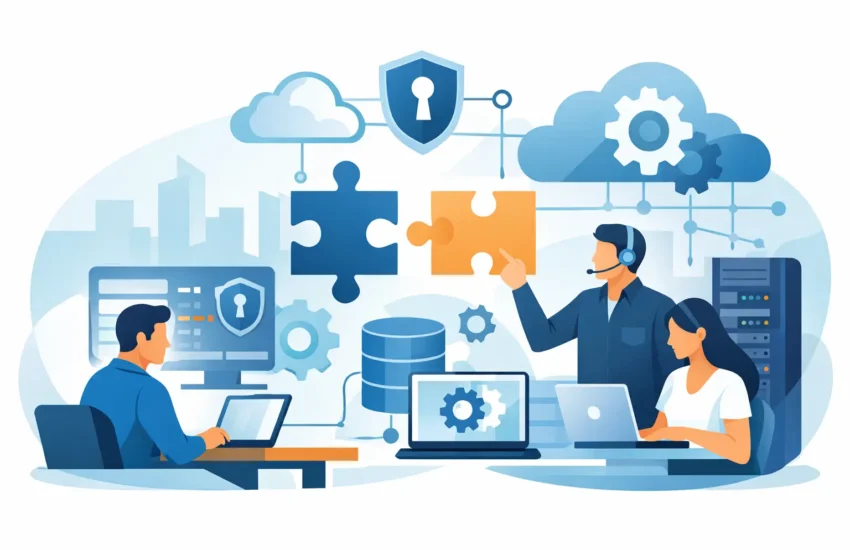
System administration is broader than resetting passwords or checking whether a server is online. In a business environment, it usually includes managing servers, user accounts, security settings, backups, patches, cloud platforms, storage, virtualization, and the day-to-day health of the systems your team depends on.
When these responsibilities are outsourced, an external IT partner takes on ongoing administration and operational support instead of leaving your team to react when something breaks. That can include routine maintenance, active monitoring, troubleshooting, incident response, and planning for upgrades before outdated systems become a business problem.
For many companies, the value is not that someone is available only when there is an emergency. The value is that someone is paying attention before the emergency happens.
Why businesses choose outsourced system administration services
Most growing businesses do not set out to build an internal IT department with deep expertise across Microsoft 365, on-premise servers, cloud infrastructure, endpoint management, backup strategy, network performance, and security hardening. They usually add tools over time, rely on whoever is most technical in the office, and eventually hit a point where the environment has become too important and too complex to manage casually.
That is where outsourced system administration services make sense. They give a business access to technical coverage without the cost and management burden of hiring a full in-house team. Instead of depending on one employee who may be stretched thin or unavailable, the business gets structured support, defined processes, and a broader base of technical experience.
This model also helps when the problem is not a lack of effort but a lack of time. Internal staff often end up focused on immediate issues while maintenance, documentation, patching, and long-term planning get delayed. Those delayed tasks are exactly where instability and security gaps tend to grow.
The business case is usually about continuity, not convenience
It is easy to think about outsourced IT support as a cost comparison. That matters, but it is not the whole picture. The stronger reason is operational continuity.
If your systems support accounting, scheduling, inventory, communication, customer records, production, or remote access, then system administration is directly tied to revenue and service delivery. A missed patch cycle, failed backup, expired certificate, or storage issue can create business disruption long before anyone realizes there is a problem.
A capable provider is not just fixing tickets. They are watching the health of the environment, maintaining standards, and reducing the chance that small issues turn into a day of downtime. For a business owner or operations leader, that is often the difference between IT feeling unpredictable and IT feeling under control.
What good outsourced administration looks like
The difference between basic support and dependable administration usually comes down to consistency. A good provider has visibility into your environment and follows through on routine work that keeps it stable.
That means systems are monitored, updates are handled on a schedule, backups are checked, user permissions are reviewed, and performance issues are investigated before they become complaints from staff. It also means there is a clear response path when something does go wrong. Fast response matters, but so does context. The provider should already understand your environment, your priorities, and which systems need immediate attention.
The best relationships also include communication that makes sense to non-technical decision-makers. You should know what is being managed, what needs improvement, what risks exist, and what action is recommended. If every conversation feels vague or overloaded with jargon, that is a warning sign.
Where outsourced system administration services help most
These services tend to be a strong fit for businesses that have outgrown ad hoc IT support. Maybe you have a few cloud tools, a line-of-business application, remote employees, shared files, local network equipment, and security requirements that are becoming harder to manage. Nothing may look especially complicated on its own, but together they create a system that needs active oversight.
They are also valuable for organizations with a small internal IT presence. A single IT manager or generalist can accomplish a lot, but not every company can expect one person to provide after-hours coverage, advanced troubleshooting, project planning, security oversight, and daily support all at once. Outsourcing can fill those gaps without replacing internal leadership.
There are also cases where a business needs support during transition. Cloud migrations, office relocations, infrastructure refreshes, compliance efforts, and growth into multiple locations all increase the workload on systems and staff. During those periods, outside administration can add stability and execution capacity.
Trade-offs to consider before you outsource
Outsourcing is not automatically the right answer for every company. If your organization has a highly specialized environment, strict internal control requirements, or a mature internal IT team with enough capacity, full outsourcing may be unnecessary. In those cases, co-managed support or project-based assistance may be a better fit.
There is also a real difference between providers. Some are reactive ticket shops. Others are built for ongoing system ownership. If your business wants fewer interruptions and stronger long-term performance, you need the second type.
That means asking practical questions. Who is watching systems after hours? How are patches and backups verified? What happens during an outage? How are recurring issues documented and prevented? Will you have one point of contact, or will every issue start from scratch with a different technician? The answers tell you whether the service is designed for continuity or just basic support coverage.
How to evaluate outsourced system administration services
Start with your business needs, not a list of technical features. Think about where downtime hurts most, what systems are essential to daily operations, and where your current support model falls short. Some businesses mainly need stability and faster response. Others need stronger cloud management, better security practices, or help supporting a hybrid environment that mixes old and new systems.
From there, look for a provider that can support the full environment you actually run. That includes cloud services, on-premise infrastructure, workstations, mobile devices, and the network that ties everything together. If support is fragmented across multiple vendors who do not coordinate well, issues tend to take longer to resolve.
You should also pay attention to how the provider talks about service. Strong outsourced administration is usually framed around uptime, maintenance, monitoring, response, and planning. If the conversation stays limited to break-fix support, the relationship may stay reactive.
For businesses that need dependable, ongoing support, this is where a company like BizByteIT fits naturally – especially when the goal is to keep systems available, covered, and supported without building a large internal team.
A better IT relationship should lower stress, not add to it
When outsourced system administration services work well, your team notices fewer interruptions, not more meetings. Employees can access what they need. Problems get addressed before they spread. Leadership gets clearer guidance on upgrades, risks, and priorities. IT starts supporting the business the way it should – quietly, consistently, and without constant firefighting.
That does not mean every issue disappears. Technology still requires decisions, budgeting, and change management. But with the right support partner, those decisions become easier because they are based on real visibility and day-to-day operational knowledge, not guesswork after a disruption.
If your business has reached the point where systems are too critical to manage reactively, outsourcing administration is not just about handing work off. It is about putting structure around the technology your operations already depend on. The right support model gives you room to focus on the business, while the systems behind it are being actively maintained by people whose job is to keep them that way.
The best time to address IT instability is before the next outage forces the conversation.
